How to create an ideal week
Let's create an ideal week without losing our minds. Because things are not always ideal and we both know that — but the ideal week helps you plan your activities, priorities, and non-negotiables so you are actually taking steps toward the week you want instead of just surviving whatever shows up.
Weeks get loud fast. One minute you are feeling motivated, and the next you are behind on everything and eating something random over the sink. This is a way to get ahead of that.
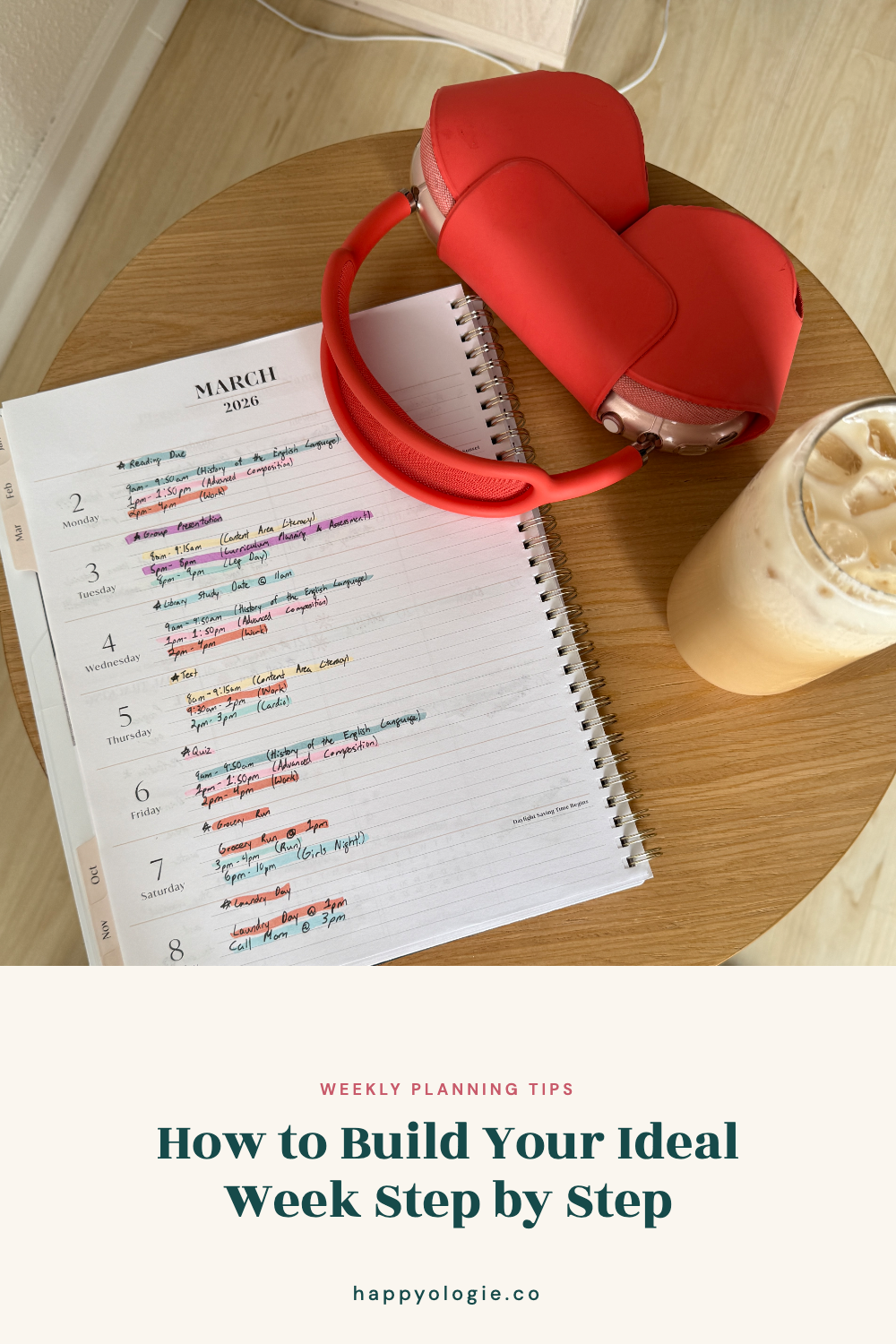
Step 1: Lock In Your Non-Negotiables First
These are the things you cannot skip without your whole week getting weird. Think of them like the base of your phone battery. If you start low, everything else drains faster.
Start with sleep. Pick a bedtime and wake-up time that makes sense for your real life, not your dream life. When sleep is locked in, school is easier, your mood is better, and you can think straight. Next, block your classes, work shifts, practices, and anything already set. If it is fixed, it goes on the calendar first.
Then add meals — you do not need a full meal prep era, just give meals a place in your day so you are not running on vibes and energy drinks. Add movement next, whether that is a gym session, a walk, or stretching. Two or three days is a win. Last, add any other fixed commitments: tutoring, therapy, family plans, club meetings, appointments. Once these are in, you can see your real free time. That is when planning gets way easier. Time blocking is the most practical way to do this if you want a more structured approach.
Step 2: Block Your Priorities
Now move into the things you want to get done. Priorities are not everything on your to-do list — they are the main things that make you feel like you are keeping up. The usual ones: studying and homework, big projects, chores, social time, and rest.
The key is to stop saying "I'll do it later" and start giving things a specific time. Instead of "study," write "study Monday 4 to 5." Instead of "clean room," write "clean room Saturday 11 to 11:30." One laundry block and one quick reset block can save you a lot of stress. And yes, schedule fun — social time and downtime are part of a healthy week, not a reward for finishing everything else.
Leave one or two buffer blocks open on purpose. A buffer block is open time you protect for stuff that pops up — extra homework, a rough afternoon, a friend who needs you. If your schedule is packed with zero space, one change can unravel the whole week.
Step 3: Review and Reset Every Sunday
Every Sunday, take 10 to 15 minutes to look back and reset. What worked? What did not? What do you want to change? If a study block was too late and you kept skipping it, move it. If you planned too much, cut it down. This is how you learn what actually works for you instead of just repeating the same week.
Then pick your top three goals for the new week — clear and simple, like "finish the history project" or "get back on a sleep schedule." Place those goals into time blocks. The Sunday reset guide on Happyologie walks through this whole process if you want to make it a consistent habit. And if you want some prompts to make the reflection part easier, the weekly reset journal prompts post has three good ones to start with.
Your Ideal Week Is a Vision, Not a Promise
Even though your ideal week is not a guarantee — and honestly there are weeks where it goes completely sideways — it is a way to cast a vision for what you want. It helps you plan for what matters and make intentional choices instead of just reacting to whatever the week throws at you. Start with your non-negotiables. Block your priorities. Leave buffer space. Reset on Sunday. Adjust as you go. And if the whole system stops feeling like it fits, the post on when an ideal week isn't working for you is worth reading.
How to use time blocking to build a weekly schedule that actually holds
How to do a Sunday reset that helps you plan the week you actually want