Organizing Your Workspace with Desk Drawers
If you have ever opened a drawer for a pen and found a charger, a lip balm, and every pen except the one you like, this desk drawer organization guide is for you. You can give your school or work supplies a place without replacing your desk or buying a drawer full of matching bins.
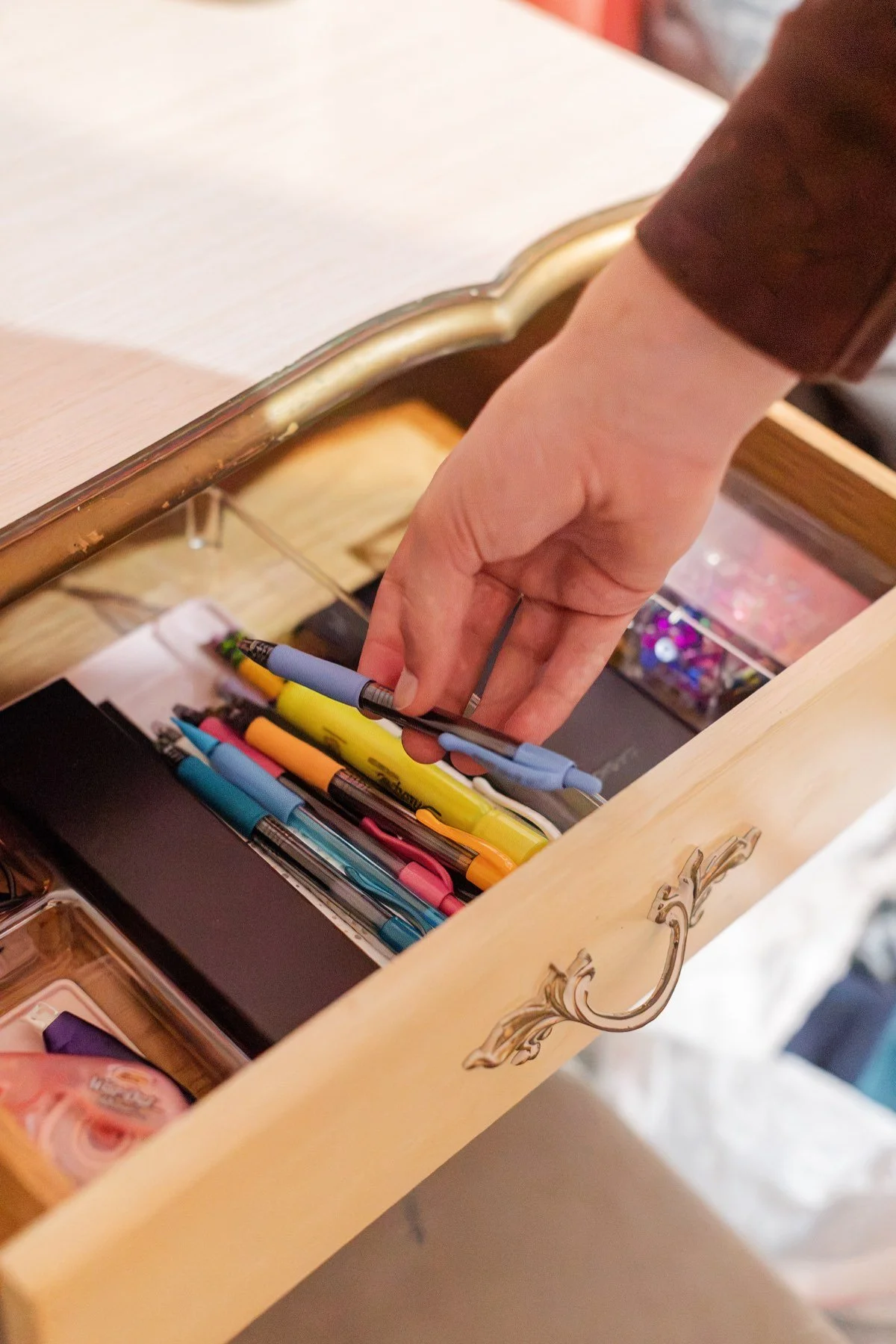
Start with what you reach for during an ordinary day. Keep those things close, give spare supplies a separate spot, and leave room for your hands to put things back. The photos here show clear trays holding pens, highlighters, and small personal items in a wooden drawer. You can use the same idea in one drawer, three drawers, or a pouch that moves with you.
This post contains affiliate links. If you buy through them, Happyologie may earn a commission at no extra cost to you. As an Amazon Associate, I earn from qualifying purchases.
Start desk drawer organization with one drawer
Empty one drawer onto a clear surface, then sort what belongs there before putting it back. Starting with one keeps the job small enough to finish before you need your desk again.
Test the pens. Match each charger to a device you still use. Put loose papers into two groups: things you need to act on and things you need to keep. Recycle what your local program accepts, and move items that belong elsewhere to their usual homes.
You may find supplies you use only a few times a year. Keep those if they still serve a purpose. They can go in a backup box or another drawer rather than beside the pen you reach for every morning. A stapler does not have to prove its worth every day.
Before you refill the drawer, wipe out crumbs and dust. Let it dry, then place your largest everyday item inside first. That might be a pencil pouch, notebook, or calculator. Build the smaller spaces around it so the drawer closes without pushing anything down.
If you run out of time, put the keepers back by group. You can add containers later. Finding your charger is already a useful result.
Give daily, weekly, and spare supplies their own spots
Keep daily supplies closest to the front, weekly tools farther back, and extras in a separate area. These groups work even when you have only one drawer.
Your daily group might hold two pens, a pencil, a highlighter, sticky notes, and the charging cable you use at your desk. If you work with paper forms, a small stamp or date pad may earn a place here too. Choose from your own day rather than filling the drawer from someone else's list.
Weekly tools can include index cards, sticky tabs, a stapler, or headphones. Put these behind the daily tray or in a second drawer. If you use flashcards every evening, move them forward. The labels describe how often you use things, so they can change when your week changes.
Spare notebooks and unopened pen packs can live in the bottom drawer or a box on a shelf. Keep one working pen nearby and store the whole refill pack with the extras. That gives your hand space to reach the things you use.
For a desk shared by school and work, give each set of papers a folder. If you plan your tasks with a weekly student schedule, keep the current week's supplies close and store next month's materials elsewhere.
Use trays to keep small items from mixing
Use a few shallow containers to stop pens, clips, and cords from sliding into one pile. Measure the inside of your drawer before buying anything, including the height below the frame.
A long tray can hold pens and highlighters. A smaller cup or box can hold clips, erasers, or sticky tabs. Leave a little space between groups so you can see what is there and lift an item without emptying its neighbors.
The clear trays in these photos make the groups visible. Small boxes or spare containers can also work. Try the layout with what you own for a few days before you decide whether you need desk drawer dividers and bins. Check the product's measurements against your drawer before ordering.
If a divider slides when you open the drawer, change the fit or put a suitable liner beneath it. Avoid filling every inch with containers. The empty part is useful when you need to lift a notebook or return a cable in a hurry.
For cords, make a loose loop and use a reusable tie. Label similar cables if you often mix them up. Keep the label where you can see it without unwinding the whole thing.
Make a separate space for personal items and papers
Give personal items a small tray of their own so they stay out of your writing supplies. If your desk also serves as a getting-ready spot, a lip balm or compact can have a place without taking over the pen tray.
Keep caps on liquids and follow each product's storage directions. A small container gives these items a clear boundary. When that space fills, check what you still use before adding another tray.
Paper needs a different kind of home. A folder marked “to do” can hold a form to sign or a receipt to submit. A second folder can hold papers you need to keep. For private school or work documents, follow the rules for storing them securely rather than leaving them in a shared drawer.
If the same paper keeps moving from the desktop to the drawer and back, write down the action it needs. “Send this form” gives you a next step. “Sort papers” leaves you with the same pile tomorrow.
A desk drawer can hold personal things and still work for studying. Keep each group small enough that you can see where one ends and the next begins. Your favorite lip balm can stay. It does not need four roommates.
Keep space to use your desk and move your chair
Keep the area in front of you open for the work you are doing. Put your notebook, laptop, or current folder there, then store extra supplies within reach.
OSHA's desk space and storage guidance explains that crowded work surfaces can push computer tools into awkward places. It also recommends keeping storage clear of the space your legs and feet need. A bin under the desk is only helpful if you can still sit comfortably and move your chair.
If you have an adjustable desk with drawers, check that the drawer opens at the heights you use. Make sure the cables have room to move when the desk rises. Follow the desk maker's setup and weight guidance rather than guessing from how much fits inside.
You can use this storage method with a fixed desk too. Start with the furniture you have. For screen placement, lighting, and the rest of the surface, follow the study desk setup guide.
A clear desktop also leaves room to use paper notes or spread out an assignment. Put the tools you need for that task on the desk, then return them when you finish. You do not have to hide a notebook while you are using it.
Adapt the same groups to one drawer or no drawers
If you have one drawer, place daily supplies at the front and less-used tools behind them. Keep spare packs somewhere else so the drawer can hold what you need now.
If your desk has no drawers, use a pencil pouch and one folder as a small work kit. A handled box can hold the same daily group on a shelf. When you sit down, bring the kit over. When you finish, return it to the same place.
For a shared desk, choose a pouch or tray for each person. That keeps your notes together and makes it possible to clear the surface for the next person. Agree on a home for shared supplies such as scissors or a stapler.
The British Council's tips for a tidy desk include keeping only what you need on the surface and using a box for small items. You can apply that idea with a container you already have.
If you like working at the kitchen table, a portable kit may suit you better than a fixed drawer layout. The useful part is knowing where your supplies go when the table needs to become a table again.
Give the setup a short trial before changing it
Use the drawer for a few days, then move anything you keep reaching around. A layout that looks good while empty may need a small change once your school or work week starts.
At the end of a session, return the items you used and remove the trash. If a full reset is more than you have time for, put your pen back and clear space for your next notebook. Small habits for students can help you choose a repeatable step that fits your day.
During a weekly check, look for empty supplies, loose papers, and things that landed in the wrong tray. You can pair this with a weekend reset routine if you already use one. Pick a time that fits your week.
If you still put off starting, study starters for days when you do not want to study offer a separate next step. Finding your pen removes one small interruption. The assignment may still take effort.
Leave the drawer ready for the way you use it. There can be a bright highlighter, a favorite notebook, and a little spare space. You get to keep the parts that make sitting down feel like your own day.
You might also like
Small school habits you can keep using
Study habits for your college week